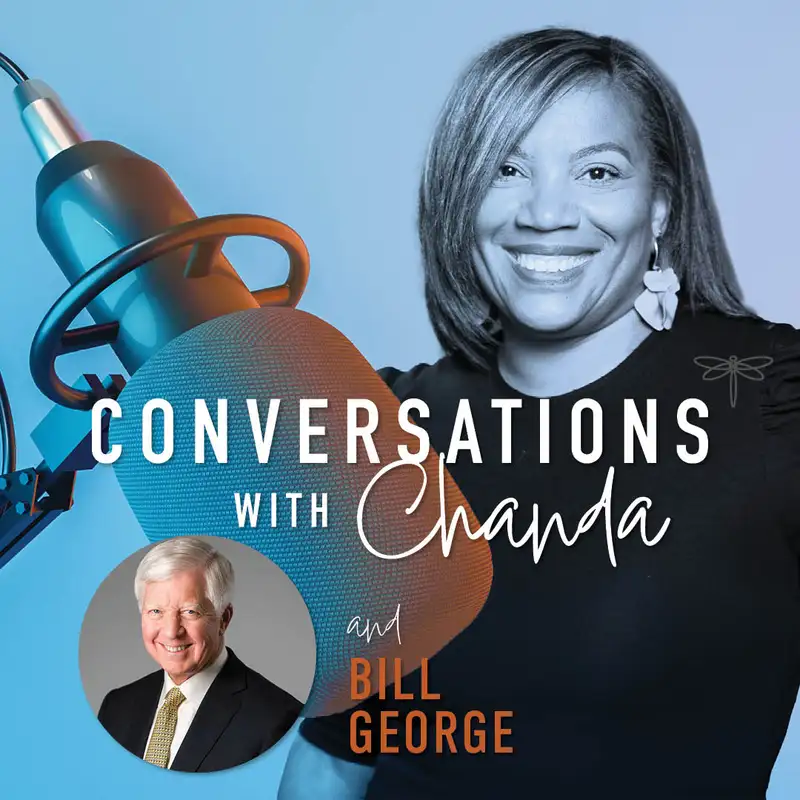
Chanda Smith Baker: Hello, community. You are listening to Conversations with Chanda, where leadership gets real and personal. This is where we cut through the noise to confront the issues shaping our world and our community. From power and justice to the heart of community change. Hosted by me, Chanda Smith Baker, President and CEO of the Saint Paul & Minnesota Foundation
Souphak Kienitz: This episode is a special one. Chanda was invited to join the StewardVerse Business Forum on Earth Day at The Hennepin in Minneapolis. She sat down live in front of an audience with the keynote speaker, Bill George. StewardVerse Strategies, based in Excelsior, Minnesota, convened about 100 business leaders, investors, innovators, students, and civic voices to explore what it means to lead in service of people, nature, and future generations.
It was the right room for this conversation. Bill is the former CEO of Medtronic, a Harvard Business School Executive Education Fellow, and the author of Authentic Leadership and the True North series. If you have not encountered his work, today's a good day to start. What you're about to hear is a real, unscripted conversation about what it means to lead yourself, the difference between relationships that last and relationships that are transactional, and why courage is the quality most missing in leadership right now.
This was captured live. You may hear the room. That's on purpose. Here is Chanda and Bill George.
Chanda Smith Baker: So you have spent a lifetime in leadership and thinking a lot about what it means to be true to oneself, and, um, most of us have learned about authentic leadership through not just your words, but how you have shown up.
You've created learning space for emerging leaders, for leaders that need to be refreshed, um, and you have done so very publicly, which feels quite different than a leader who leads, um, becomes philanthropic, maybe goes. You have seemed to make a lifetime investment in making sure that other leaders are supported.
Why?
Bill George: First of all, I want to thank you, Chanda, for heading up Minnesota's, uh, largest foundation, and, uh, I do feel in this time of a K-shaped economy that it's really important that those of us with, uh, financial resources are giving back to those who don't have it, particularly at a time when the government's cutting off a lot of resources that are affecting people.
So thank you for your leadership. I think this kind of leadership in our community is very important. So, you know, I, I have to say, uh, throughout my life, I got a, a career. I got a lot of, uh, encouragement to, uh, change my outward style and to do things differently. And I even was sent by two companies to style training classes, and I failed both of them.
Uh, I realized as I was coming to-- while I was at Medtronic, that I felt like all the pressures on leaders to perform, to behave, to look a certain way, act a certain way, were totally flawed. And, uh, and so I wrote a book with-without a lot of research, uh, called Authentic Leadership back in two thousand and three, saying, "Why can't you be who you are?"
And I was always surprised, Chanda, that people would say, "What does it mean to be authentic?" And I said, "Well, it's pretty obvious. It's genuine. To be the real you. Be who you really are." I realized what was behind the question is people feel they had to wear a mask, or they had to put the armor on to go into the comp-- They had to be something different.
They had to fall into those of you who work in corporations or companies or even any other organs-- like government organization. You have to fall into a certain mode, and that may not be who you are. And my whole message, I think, is to be who you are. But I think underpinning that is a deep commitment to we only go around once in life, and I think, why are we here on earth?
We have to ask ourselves, whether you have a religious faith or not, uh, you have to answer the existential questions of why are we here? What am I contributing to the world? You've obviously contributed a lot yourself. But, you know, and then how do I lead? Do I lead with values, or am I just a person trying to get ahead and cut other people out and make it to the top?
And we have a tremendous amount of that, that I've seen in the past. And, uh, so I think the reason I've been so public is I wanna encourage more people to be true to their values. And I would never tell what your values should be, but I think it's important to be true to your values. Otherwise, I really don't know who you are.
If you say, "Chanda, I have..." You tell me, "Bill, I have these values," and I see you a year later, and you say, "Well, no, I've changed all my values." You, you can change your company, your direction, who you work for, uh, you know, but I think it really... When you start changing your values, I've lost track of who you are.
So I think you really need to not only know yourself but have the courage to speak out on behalf of what you believe. And that's one quality I see missing in a lot of leaders today, is courage.
Chanda Smith Baker: Uh, we should talk more about that in a second. Yeah. Um, so I have a, a quote here, um, "The hardest person you will ever have to lead is yourself."
And so you've jumped in that a little bit, but, um, it sort of centers around values, but there is something about the, uh, discipline, I think, when there's-- when you're being pulled in so many different directions. Yeah. Can you say more just about that?
Bill George: Well, I think many of us, uh, really are trying to please external forces, and we lose who we are.
And, uh, and so I think a lot of times it's hard to lead yourself because we get off track because we're trying to please those external forces, and we really aren't true to ourselves. And, uh, and, and so when I was interviewing people for my book, True North, this, this is the third version of this, but Chanda, uh, uh, we found that people really want to talk about the difficult times they faced in life rather than just their success story.
They didn't want to just be a success story. They wanted to talk about the difficult time w-- that shaped them. And what we learned was that people are shaped more by the most difficult time, what we call a crucible, uh, in their lives than they are by success because success reinforces, uh, uh, your image of yourself.
But you really, when you have to go through a difficult crucible, you get fired from your job, you lose a loved one, you have a life-threatening illness, you lose your family for whatever reason, uh, that really forces you to look at yourself in the mirror and say, "Who am I?" And I think it's that time when you face yourself and you don't have a title.
Nobody's gonna look in for titles, you know. Uh, I actually once had a boss who was lobbying for a title when he retired. He wanted to be chairman emeritus, and the board kind of laughed at him, and he got really angry, and I said, I said, "What got you so upset?" And he just said, and this is a highly successful individual.
He said, "Billy, you don't understand. Uh, without a title, I'm nothing." Now, isn't that sad? You know, uh, can't we just be who we are? Uh, do we need a title? And so I think we need to strip away all that pretense and say, "Who am I at my core?" And that's what really counts. And I see a lot of CEOs, Chanda, that go off, and they form all new friendships and become CEOs, and they fly around in private planes, go all over the world, play golf and, you know, at, at wherever, Torrey Pines, uh, or Pinehurst.
Uh, but when they lose their job, all of a sudden everyone turns away from them, and they realize what really counts. I think it's much more important that you really are in touch with your family and your friends you've had for many, many years. This morning, I was meeting with a friend of mine. We've been friends for 50 years, and he's dying now.
I'm going to see him in person, uh, this afternoon. Um, those relationships are really... That's more important, and the CEO relationships are more superficial.
Chanda Smith Baker: Yeah. I mean, so where you're going to me with that topic is that, um, the transactional-
Bill George: Yes,
Chanda Smith Baker: very ... right? So that all your relationships are based on what you do, not who you are.
Bill George: Right.
Chanda Smith Baker: And so-
Bill George: I say that, that, that's really a key thing you said.
Chanda Smith Baker: Um,
Bill George: yeah. What you do, not who you are.
Chanda Smith Baker: Yeah, what you do and not who you are. And so there is a vulnerability to deepening those relationships, right? To, there's an exposure that can be quite uncomfortable, um, in leadership. And as a matter of fact, some people are, are raised, right?
Like, you don't go to work to be friends with people. You go to work to work. You go to school to learn. Why are you talking to people? You're there to listen, right? Like, all these messages that we get growing up, I think inform us in terms of how we approach leadership. And so if there are people in the room who, um, are feeling perhaps, uh, empty in leadership, any advice on how they go beyond the transactional?
Bill George: Well, I think it's important, those deeper relationships, and finding people who can you really count on that loves you or likes you or admire, or is willing to be your friend, good through good times or bad. And those are relationships you never wanna break. And it is those long-term relationships that really count.
And in, I think in an authentic organization, you have a lot of those relationships that are not just transactions. In a transactional organization, people come and go, a lot of people are on the make, and they'll take the next job that comes along without real commitment to the organization's purpose and its values.
And I think it's far more important that you build those relationships, and that leadership encourage those relationships to be built, and to look at that. And, uh, there's a whole thing out now about, well, pe- companies, people are not loyal to their company. Well, owners are not loyal to companies, companies haven't been loyal to them in creating a long-term organization which really honors the contributions.
Look, and people, okay, if people peak, maybe they have to move to a lower level position, maybe they have to retire, but you can always treat people with dignity and respect for what they do.
Audience 1: Mm-hmm.
Chanda Smith Baker: So let's, let's jump into courage.
Bill George: Yes. Thank you.
Chanda Smith Baker: So, yeah, you're welcome. We are living in a moment where we are constantly being assessed, leaders are being assessed by their level of courage, right?
We're living in Minnesota. We just had many moments where, um, there was an evaluation of what courage looks like in a moment that required it What do you have to say? Let me even back up, 'cause my question really
is, David made a mention of the leaders of twenty-five years ago, right? I have an impression of the leaders of twenty-five years ago, um, that were coming up in this community that were very present in issues, and community, and leadership, and, like, the civic conversation. I don't see that as much, but maybe it's moved somewhere else that I just don't have line of sight.
Bill George: No, it has moved. We've lost sight of community and how important community is. You can be a big global company. You can sell your products all over the world. You can source your products all... But community really matters. This is your home. It matters to your employees. You wanna create a community. It's a great place for people to live.
You wanna create a community that, uh, you know, it has great education, it has great healthcare, and great parks, and sports teams, and fun, and... But, but more importantly, where people are committed to that community. So in the ICE invasion, which I confess I was missed, uh, the first 10 days of it for being in Australia, um, there were leaders in this community that wanted to step up, but many of the business leaders did not, and would not even stand up on behalf of their employees for fear of the man in the White House or for fear of being attacked by ICE or something.
I don't know what their fear was. But, you know, these are some of the most powerful people in the world, and you didn't hear a word from them. They were very quiet. So who stood up? The community. You know, I, I, I missed that. I was out of town, but I wish I'd been there. I can't even imagine what it is to be downtown here in Minneapolis, minus twenty-one degrees Fahrenheit.
I tell people around the world this and around the c- country. They can't believe. They don't even wanna... I got some wax under the windshield. It's minus thirty. And what's it like to be down there for two, three hours moving in a big crowd, uh, and frankly, I'll be very honest with you, people of color were afraid to come out for being arrested to those events.
So these are folks that are really standing up for strangers because frankly, almost everyone who was detained or stopped, or I know one little girl who was seven happened to be, have brown skin. They said, "Oh, you look foreign." You know, I mean, this is terrible, but this is what was happening. Who's gonna stand up for these people?
For these people, our people, people in our community. And it became a great example of people coming together in the community. Fifty thousand people, downtown Minneapolis. True. And when, uh, the, uh- The rally, I believe at the Capitol, had 150 to 200,000 people there. Quite amazing, you know? And so I think this is what we as leaders are leading a community, and that community really matters.
I was talking to Trey Launder, thank you for sponsoring this conference, and I said, "You know, when I go, I go to Lunds all the time, Lunds & Byerlys. When I go in there, I'm not gonna see you. I'm gonna see a frontline person, and how they treat me determines whether I'm gonna come back. If I'm well treated by those people, I'll come back and I'll feel good.
I have a good feeling here. Or my wife gives me a grocery list and there's some things on the i- I have no idea where these things are. Would you help me find them? You know, where's, where's the canned coconut milk? I know it's coconut. I don't know what the can..." You know? And so can somebody... These are frontline people.
That's who you see. When you go into healthcare, who do you talk to? You talk to a nurse, you talk to a doctor. My son's a doctor. You know, these are the frontline people you interact with, not the CEO. So we as leaders of these organizations realize that the community we create with our frontline people, they're probably the lowest paid people in your company.
Let's be honest, the bagger at a Lunds store, probably not the highest paid person. But I think those people make a difference. And so those people, being the people at the front lines, we need to recognize the value of that, uh, and the community we create among them. You said people don't have friends at work.
Well, you spend more time at work than you do anything else, more time than you do with your families, more time you do with your friends, more time than you do with yourself. Mm. So I think it's important that you have those relationships. In fact, Gallup found years ago, and repeated this for 30 years, uh, that people had the greatest satisfaction at work is people that had a best friend at work.
Chanda Smith Baker: Mm. Yeah. When, um, when my kids were little, I would say, "I gotta go to the store," and my youngest would be like, "Can we go to the store with the carpet?" To Byerly's. So, um, I don't know why I just thought of that, but he, he used to be very entertained by that. Um, Bill, you're, you're raising a point around, um, community.
What you did not say in any of what you just said was- Politics
Audience 2: Yeah
Chanda Smith Baker: How do you separate in a moment that is politically divisive, right, from the needs in community? Because it feels like they are converging in a way that isn't allowing people to see the, the difference.
Bill George: They do, and we're split, and we're split, and we're left and right, red and...
I hate all these things, to be honest. Uh, that's not of interest to me. Uh, if any of you think you're really gonna in- influence the, the President of the United States or the people in the White House, boy, you are seriously deluded. In fact, during the United States invasion, the CEOs realized none of them had any, enough contacts to have any influence, and they had no influence, okay?
No, no, I mean, you really are. So what can you do? Where can you make an impact? Even your foundation, huge foundation, you know, you're probably not gonna have that in, much influence on the White House, but you've got influence on the lives of people right here. Isn't that what you're calling as your purpose?
And so I think not, I don't wanna get engaged in politics. People say I am by taking positions about leaders, but I think it's much more important. So I'm gonna give you an example if I can just take a minute, Chanda. Yeah.
Audience 1: Yeah. Yeah.
Bill George: Because, okay, I, I served on the board at Target for twelve years. I watched Target grow up from a little company into a large company, and, uh, the CEO, Bob Ulrick, frankly, who was a social conservative, took the position that the only way we can compete against Walmart is to serve different groups, 'cause Walmart's basically blue collar white males.
And so he said, "When women come into our stores to buy things for their kiddies, we wanna have great things for them to buy too. We wanna serve Blacks, we wanna serve Hispanics, and we wanna serve LGBTQ." They would say quite openly, "We're the most gay-friendly company in town." The former CEO, not Michael Fidelke, who I think is a terrific guy, the former CEO, whose name will go unmentioned, six days after the inauguration abandoned what they stood for: diversity, equity, and inclusion.
Now, who doesn't want an inclusive organization? You got, they have four hundred and forty thousand employees. How many employees do you have? Don't you want everyone to feel a sense of belonging, that you feel included, okay? And when people are considered for promotion, don't you provide equal opportunities for people?
If you don't, there's something wrong. And you have a diverse organization. Costco, uh, and Target has really suffered from that Costco, and I think Michael Bedok is trying to turn that around. But Costco, on the other hand, got challenged. Seventeen states attorney general telling them they had to drop DEI, and they had a shareholder suit.
They had, uh, an activist investor trying to take over the company. So the CEO is new, Ron Bakris. Ron Bakris started as a forklift driver. He's been there forty-one years. You
Audience 3: know, this is
Bill George: not some fancy guy with PhD. He's a hardworking guy, and he got to-- he said, uh, "You know," to the board, "I don't want all the people in management to look like me.
We have-- We're serving in a very diverse population base. We're gonna stand up for what we believe, and let's take this to a vote of our shareholders." And when they got-- when the shareholders voted to actually restudy or frankly eliminate diversity, equity, inclusion, ninety-eight percent of the vote of the shareholders voted with management to retain it.
Okay? So don't be so sure about it. I can tell you Costco's got a lot of people who vote Republican there. This is not a political issue. They said, "This is what the company stands for." See, it's really to those shareholders. They say, "We like what the company does," and have membership. So I'm just using this to compare, contrast.
Chanda Smith Baker: So but how does, how does one... Because it's very noisy.
Bill George: Yes, it is. It's
Chanda Smith Baker: really, really noisy. And so how, how do leaders today sort of rise above the noise for-- to get to a decision like that? Like, I think you've already answered it, but I'm gonna ask it anyway. But how do you, how do you get there? Well,
Bill George: you know, I, I meet with a lot of group CEOs.
I said, "You've been-- You're company-- How long has your company been around?" I met with one the other day, a hundred and fifty years, a hundred years. Well, this too will pass. If you-- Your company's been based on certain things, like J&J with the credo. If you're based, if you have certain principles, uh, and you change those because of political pressure, well, there's gonna be a new government in in four years.
You know, this government wants to eliminate the Foreign Corrupt Practices Act, but I can tell you, there's gonna be a new government in in another four years that'll probably be enforcing it. So your company better stand up for its values and do the right thing. And so I think that it's really important that realize the timeframe.
Don't be short-term oriented. Don't be just be transaction-oriented. Yeah, if you take a hit, as a CEO, I can tell you personally, you're gonna take a lot of hits. So if you can't take it, you know, as Harry Truman said, "If you can't stand the heat, get out of the kitchen." If you can't stand the hits, you shouldn't be CEO.
You shouldn't be, shouldn't be owner of the company. You're gonna take the hits. But stand up. The world will, the, the world will move on, but you'll still be there, and you'll stand up for what you believe.
Chanda Smith Baker: So-
Bill George: Sorry to come on so strong
Chanda Smith Baker: No, I mean, I appreciate it. And actually, I wanna ask if you would be willing to share a moment where you had to make a choice.
One of those moments that we talked about earlier where you're, you, you have to make a decision between hard things, where you've taken a hit. Like, what did you... You said that that's where you learn, right? That's where you, you get to understand if you're leading through values or what your lens is.
Bill George: Well, you'll think this is a trivial decision, but at the time it was not.
Medtronic, when I went there, considered itself a Christian company, and I'm, I'm Christian, but you know, I felt we had to diversify the company in many way- ways to welcome all kinds of people, and we did that with our so-called Christmas program, now called the holiday program. But we had these affinity groups, and we had a, we had a, um, we had a Black group, we had a Latinx group, we had a women's group.
So a group of gay employees came to me and said, "We'd like to have an LGBTQ group." Good. Fine. And I gave them some budget funding to get their group started so they could meet regularly and do things like that. Well, somehow this got out into the media, and it became a, a big story in the, the... I don't know why, but in the Star Tribune.
So there's a big headline in the Star Tribune. And we had actually decided, we had a foundation that, uh, had a principle that we did not fund organizations that discriminate. And the Boy Scouts, who was a great organization, but at that time, they got a Supreme Court ruling that they could discrim- they, they could discriminate against gay scouts and gay scout leaders, and we felt that was wrong, so we defunded.
This all became a big headline thing. And so, uh, boy, I got hundreds of letters from employees saying, you know, "God is gonna turn against us," and, you know, "This is terrible and it's just awful." And I said, "No, this is what we stand for. We stand for our people, all people." You can't just say, "Well, I stand for everyone who does this," but you know, I mean, these...
And so we had to stand up for our employees and just say yes, and I will affirm that. And I called, I got a number of letters from employees, some of who worked on production lines, so I called them up or visited them and said, "Tell me, what are you upset about?" And so we had good, honest discussion about what they're upset about, and I tried to explain to them, this is what the company stands for.
We stand for all of our people, and we of course will support various groups. And, uh, this is kinda back in the news age. This was fifteen years ago, or twenty-five years ago. But, uh, yeah. And, but it's just kinda thing, you have to make a decision. Mm-hmm. And you make it in real time. And there's no formula. Uh, you know, you don't consult some con- You don't bring in McKinsey to do a study of it.
Chanda Smith Baker: Uh, any questions? I'm scanning. Yep.
Audience 3: Um, I really appreciate what you're talking about with authenticity. When every business is focused on artificial intelligence as the new way forward, which is artificial and a combination of all the average of all the inputs across the world , um, how do you keep authenticity front of mind for leadership and the day-to-day of what people are doing within the businesses?
Bill George: Well, let me say that- Uh, AI is going to have a dramatic impact on every organization and, uh, in this room and every organization. No one is going to so-called escape this. Uh, I said, I quoted the Wall Street Journal a couple of days ago, "I think CEOs are looking at this all wrong. They're looking at it, how many people can I take out?
'Cause I don't need all these people." I think we're looking at it the wrong way. I really do. The real opportunity, as Souphak Pak from Ecolab says, is to create new revenue models. If you look at the most valuable companies in the world, they all have whole new business models. You know, I mean, Google had search and, and have some problems with Meta, but they have created social media, and you go right down the line.
Amazon created online retail. And so I think we're gonna-- the success will be for all of you is in creating new business models. Now, you'll have to do the efficiency. It's what we call table stakes. Everyone's gonna do the same thing. But I think you want to rethink your organization. In fact, if I were advising folks in this room, I would flip your organiz-- And I think we need fewer managers and a lot more leaders.
And I would ask your so-called managers not just be controlling budgets and people, but get out there on the store floor and work with people. Get out into production. Go into the labs. Work with your people. Our surveys show that CEOs and corporate leaders are not doing that anymore. They're too busy in meetings.
No, get out with the people. That's what they actually-- Get on the front lines. Find out. You're gonna hear everything will be unfiltered. You're not gonna have a big chain of command. In fact, I'll go one step further. I would flip the organization on upside down, and on top, I'd have customers. Then I'd have the front-line people.
I told you my son's a doctor. He's a surgeon. He's a front-line worker. People that work at Best Buy are front-line workers. The people at Medtronic that are inventing things are front-line workers. These are the people who want support, and then everyone else is there in a support mode for those people.
Think of yourself and enabling them to do their job. We're gonna need leaders who can see around corners, can have the human qualities. AI can tell you everything that is today, okay? But they can't tell you where things are going in the future. That's the job of leaders. That's to look. That's to understand the nuance and the subtleties in real time.
So rather than just looking at what is today, where are things going and having that caring. Now, I realize there are AI studies showing, Chanda, that, uh, people would rather talk to, uh, an AI agent than talk to their therapist. Now, that may be a problem with the therapist more than the AI agent. But I think the human side, being authentic, is what's gonna be really critical.
So you're not gonna need all those analysts. You may not need-- I know some you represent consulting firms, but you may not need to hire someone to come in and tell you how to run the place. You just need to figure out how can your organization be much more human and much more in touch with your customers, your clients, the people you're serving.
Uh, and I think that's critical. I-- 'cause your foundation when you're making grants, are you in touch with the people you're serving? Yeah.
Chanda Smith Baker: I mean, I say every day, we're in the relationship business. You are. So even if we're using technology, we are in the relationship business. Good. Beautiful. Yep, go ahead, Steve.
Audience 1: Uh, thank you very much. Um, Bill, Steve Young. It's good to see you again. Uh, apropos of your book and your work, and you're talking about authenticity and who am I, uh, with my colleague, uh, Tara Marshall, um, we developed a self-assessment. And I've asked Debbie to make the QR code available to all of you, so you can go take your self-assessment.
You'll get a report. I will not know your scores. And it will balance you between inner direction and other direction, being directed by yourself or being directed by others. And this goes back to the work of a mentor of mine, David Riesman, whose nineteen fifty book-
Bill George: You, you know David Riesman?
Audience 1: Oh, yeah.
He's a mentor. The
Bill George: Lonely Crowd? Really?
Audience 1: Exactly. The Lonely Crowd. Yes. Exactly. Um, and, um, that's the basis. And you-- But what Tara has really emphasized, and I wanna emphasize this, is what she calls the pull factor, which you can sort of see. What's pulling you to be inner-directed and yourself and a leader?
And what's pulling you to be other-directed, where you're following other people? So thank you.
Bill George: Well, thank you. And I, I think self-assessment's really critical. But then take that self-assessment and go out and pick out half a dozen people you're close to and ask them, how do they see you? Because I think the hardest thing I found, and certainly true in my case, the hardest thing for me is to see myself as others see me.
How do you see yourself as others see you? I don't know how you all are receiving this. I have no idea, uh, how you're receiving what I'm saying. Some of you may really dislike what I'm saying. Uh, I'm okay with that, but I need to ha- understand that. So I think you need to do both. Get that self as-- I'm a great believer in three sixty reviews, where you get really honest statements that are, um, so many people won't say it to your face, but they'll put it in writing.
And they helped me a lot during my career
Audience 4: My name is Seng Vong. Nice meeting with you
Bill George: You got a mic coming up
Audience 2: Hi, my name is and good being here. Uh, well, first your comment, um, I was in university classroom for ten years, um, in, in the past, and every class I taught, I probably cited reference to your name and then authentic leadership framework once, at least once.
So me, uh, sitting here, it feels like a public teenager sitting in front of Bruno Mars or BTS.
But now my question is, so, uh, I saw one of your YouTube clips in which you speak about the authentic leadership briefly, and then you spoke about your, uh, experience. One day you woke up, and then you saw ties and then, if I remember correctly, you saw very, think yourself very cock-buttoned, and then you said, "Oh, this is not really me."
And then you left the job. I think that was Goldman Sachs, uh, that, the job you left. Uh, what was the triggering point at that time? That's the first question. And then how you define at the time, how you define yourself at the time is same as how you define yourself now, or it has changed over the years?
Bill George: How I define myself now compared to how I used to define myself?
Audience 2: Right. And then, and then- When you left Goldman Sachs, after seeing yourself wearing cock-buttoned, ties, and then, uh, suit, I think in the video clip you said, "It's not really me wearing this attire and then going to work in a very formal setting."
And then that's when you said, "It's not really true me." So you left the job to move on to the next career. Yeah.
Bill George: Well, you know, I think each of us when we're involved with an organization, we have to ask ourselves from the time we either took over or had a role or joined a board, did we make, help make the organization better than when we left it?
And when I served on boards, you mentioned Goldman Sachs, that was my role. And when the crisis came in two thousand... Actually it came in two thousand and ten because Goldman sailed through the financial crisis as did JP Morgan. But then it got a huge amount of criticism in twenty ten that Goldman's trading against its customers and all of this.
And, uh, Lloyd Blankfein, the CEO, came to me and said, "Bill, would you head up a board committee to take, to oversee a top to bottom look at this firm and everything we're doing, what's right and what's wrong?" And we came up with thirty-nine recommendations to transform the firm, to refocus it on its values, on its pitch purpose of the client's interest always come first, and realize there are ways we get moved away from that.
And so I think you do the best you can. Nothing is ever perfect in this world. There are lots of things at Medtronic. We had quality problems, and we had a recall. That's not something you're proud of. But when you have the problem, you have to step into it and do the best you can to ameliorate it and make it better.
So that's, I think, after you look at your con-contribution to the organization Was it healthier and better when you left than when it was when you joined? And I think if you can honestly look yourself in the face and say yes, then you can say, "I've made a contribution." And you're not gonna change the whole world, and there's a lot of bad stuff in this world and a lot of bad people, but, uh, I think you do the best you can.
You can't change the whole world, but you can do the best you can to contribute.
Chanda Smith Baker: Yeah. I think the, I think the second part of his question was around- Thank you for your help. Yeah. You're welcome. Um, um, the
permission to evolve Right? Like, I think sometimes people, like, they think that they have to stay the same person, right? So-
Bill George: Well, no, it's-- Being authentic is an evolutionary process. It has to do with a grice-- growth mindset. No one has ever... If you're in a fixed mindset, that's when you, I think you're frankly, constantly mo-mo-moving away from everything.
You have to have a growth mindset, as Carol Dweck wrote about at Stanford, and that means you're constantly growing. I'm growing in this session by listening to you and to listen to the questions being asked. I think you wanna take all the inputs you get in your life and take those seriously. Some are valid, some are not.
But learn, how can I grow? How can I do better as a person? And I feel like I've been trying a long time, and I still feel like I'm growing as a leader and a person from all the interactions I have and the challenges we face today. And frankly, uh, I've had the sad situation that most of the people in my age group, uh, uh, I was close friends with have either died or are in the process of dying.
So I've adopted a lot of younger friends, and so I was talking to one who was a twenty-five-year-old yesterday, having a mentoring session with him, and I've learned a lot more from him than he's ever learned from me. I have a close friend in Switzerland who just turned thirty-two. I've learned a lot great deal from him.
So I think, uh, those are really important that we're constantly growing. So some people have misinterpreted what it means to be authentic. What it means to be authentic, you don't just say everything comes to mind. You don't say something hurtful to a person. What it means to authentic is to be real and to be genuine and to say things that are positive to help people and help be constructive.
If you have to be critical to someone, you can be constructive. And it's the same thing. You're constantly growing, constantly learning. And I think that's how we go through life. And once you stop growing, you're probably headed for the end. So keep growing.
Chanda Smith Baker: You have talked about frontline workers, emerging leaders, and now you're talking about those that you're mentoring.
What should we be thinking about for the leaders that are coming up? How are you thinking about them?
Bill George: Ah, thank you. I think we need... There's a lot of confusing messages. If you take people that, uh, say, were born in the nineties and grew up in the twenty, uh, ought- ought-- what it was called, the twenty tens, uh, man, we've had nothing but one crisis after another, starting with nine eleven and then the banking collapse, which affected a-- set off a huge recession.
And then COVID comes along out of nowhere, and then here in Minneapolis and around the world, we're affected by George Floyd's murder. And, uh, and then we've had these political upheavals, constant changes in where politics are going. And, uh, now we have all these wars. I'm, I'm frankly very anti-war. So it-- You know, I mean, 'cause I worked in the Defense Department during Vietnam, and I saw the downside and, and, uh, here we are again, you know, from Iraq to Afghanistan to Ukraine to, uh, Iran.
And this is not good for the world, guys. So but young people are really confused. So I think today we don't live in a stable world. We live in a world of chaos and crisis. So you as a leader need to think about how do you lead not from all those things you're taught in business schools about, uh, financial stability, process controls, all these control mechanisms.
Think about how do you adapt quickly in crisis, and how do you, uh, how can you deal with the chaos that's coming at you? Think about the people dealing with supply chains, how they're changing every day 'cause of tariffs and all the changes and geographic changes, or people that invested heavily in the Middle East.
These things are going very quickly to change. So you have to be that kind of leader. And you don't just need more managers that can go in and stay that way. You're gonna have to be very adaptive to changes. And I think that's the key. So that's how I'm advising people, is be that leader. Don't try to just be a manager.
Uh, I know all those underlying principles you've learned in school about accounting and marketing principles. They are important, but it's much more important you're that leader that has a clear set of values and all. You have to know your purpose, you have to know your organization's purpose, you have to know your values, you have to know your organization's values.
Those have remained constant, but then you have to pivot now rapidly in your strategies and tactics. I talked to the, uh, CEO of a very large company, Michelin, who's got thirty-two factories in North America, and I said, "How are you dealing with all these tariff changes?" He said, "Bill, we don't even do strategic planning anymore, okay?"
Uh, because we can't plan that far out. You know, we've gotta adapt so constantly to what's coming. But what you can adapt are your purpose and values. If you stand for something, you better continue standing for it
Chanda Smith Baker: Those are very different skill sets. So-
Bill George: Yes, very different both.
Chanda Smith Baker: Th-they are. Um, so I am about eight months into being the president and CEO at the Saint Paul & Minnesota Foundation.
Bill George: Mm-hmm.
Chanda Smith Baker: What advice you got for, for a new CEO?
Bill George: For a new CEO, how well are you serving your, your, the people you're serving? You're, you're really called to serve. You have two sets. You have the people who are investing in this, in, in the foundation, who's-- you're a steward of their assets. How good a steward are you, and how much are you in touch with them?
But more importantly, how well are you serving where people wanna put their resources and serving the community? I believe you are, as I said, the largest community foundation, one of the largest in the United States. You're there to serve the communities. You can't abandon the community. How well are you serving?
What are the community's needs? Having a deep understanding of the community's needs. Can you get that just from studies, or do you really need to be out talking to people and the people you're serving and getting their inputs? And then you have to figure out, how can you integrate that into a whole of where we...
You can't do everything. You know, you have to decide, what are we going to do? Who are we gonna serve? And then make-- And discern what are those things. You have to have a strategy for doing that. But that may have to change given the conditions. And just like we talked about, conditions have changed, so you may have to adapt how you're serving these communities.
And so I really-- That's why I said I admire the role you've taken on here of leading this community foundation because we need strong communities. Uh, why would I wanna move here from New York or LA if I thought this community wasn't, wasn't a really good community to be in? It wouldn't help-- But it's gotta be a healthy community.
And it can't just be healthy for the wealthy. You know, it has to be healthy for all of its citizens. So we can't just have beautiful twenty-five million dollar homes out on Lake Minnetonka. No offense to any of you that have those. It's gotta be-- No, we have to have housing for everyone, okay? We have to have jobs for everyone.
We have to have healthcare. I mean, you know, frankly, what's happening right now is healthcare costs for people that are not employed by a corporation like I was are going through the roof. If you're not on Medicare or Medicaid, or Medicare, or you fall above the Medicaid line, and, uh, man, this is a really a problem.
We need to be sensitive. How do people get Get their health taken care of. So that's what, to me, my advice is be that person who stands up and represents the community because we need more people. I wish those of you CEOs, we need more of you to stand up and represent the community, why this is important.
You know, why is Bunz and Byerlys important to this community to have you? But, you know, why can't we just buy everything online on Amazon or get everything at Walmart? No, because you have that, that personal part of the community. They're an integral part of the community, and by the way, they give back to the community.
And so I think that's really a critical role that local companies must play. So you maybe can't compete with these giant corporations, but they may not have the sense. It's like being in the banking business. Are you serving your clients? Uh, how are you gonna compete with JP Morgan when they're coming, or Bank of America is coming into the community?
You compete because you provide better local support and service
Chanda Smith Baker: Well, service is a thing.
Bill George: Yeah.
Chanda Smith Baker: And we're getting ready to become even more automated.
Bill George: Yes.
Chanda Smith Baker: And so that is, uh, the relationship is really the c- the cornerstone of this conversation. We have time for one more question. But remember
Bill George: you said earlier-
Chanda Smith Baker: Yeah.
Bill George: What'd you say? What'd I say?
Chanda Smith Baker: We're in the
Bill George: relationship
Chanda Smith Baker: business. Yeah, we're in the relationship business.
Bill George: So if your service is so automated... I had a horrible experience the other day- -with our largest local health system. I got a call. I was actually out of the United States, and the call was for a certain perturbation on my pacemaker.
And, uh, so I call back, and I get to the switchboard, and they say, "Well, who's the person calling you?" I said, "Well, I have the first name, but I don't know who it was." It was a nice nurse. She left a message, and, uh, with the message. And they said, "Well, look, where does she work?" And connected me. I went through twenty minutes of sheer hell- -trying to get through this electronic mess.
I said, "Can I just talk to a human being?" Right. When you... Has anyone ever tried to contact someone at Amazon to talk about a purchase you're having a problem with? You know? I've never been able to talk to anyone at Amazon in the last twenty-five years. So but I'm saying we can automate humanity out of existence, and you will also automate your company out of existence.
Because I wanna talk to a human being. When I come into your store, maybe everything's automated, but I actually wanna see a human being, you know? And, uh, who is it puts the quality into a Medtronic heart valve? Yes, we have automated production lines, but it's the, it's the people that work on that line that ensure that heart valve, 'cause they know one's gonna-- someone's gonna die if something's wrong.
So please don't, uh, don't automate your foundation out of existence. We
Chanda Smith Baker: will not automate philanthropy. It is a relationship business. We got one more question in the back. If you could, like, get right to the question 'cause we're right at time.
Audience 4: So you have been a leader for so many years, and you've seen so many changes.
We're facing late-stage capitalism now. Um, how would you recommend we as leaders approach the future? Um, you've already said agility and some of the other things, but you are a humanist. That's very clear. You know that we all do better when we all do better. So from that perspective, what advice would you give
Bill George: us?
Well, I think it's, first of all, be a leader. Don't just be a manager. Uh, don't just think you do everything by routine or rote. Recognize the environment you're in, which is constantly changing, and it's gonna continue changing. Uh, we are in a time of, of chaos and constant change in the world, so it's not just here in the United States.
So to be a leader in that environment, you need to be grounded in who you are. What is your-- What are your values, and what is your purpose? You need to know that. And then you wanna work with a group of like-minded people to try to make a difference in the world. We've only got one short time here on Earth.
Try to make a difference, and that starts with the people you're closest to every day Whether it's your families or the pe-- your work colleagues or w-- your friends. But I think it-- as a leader, you have to. You said you use the word agility. Yes, you have to be very agile. You have to adapt quickly. But keep constant.
Don't adapt your purpose and values. Keep that constant and adapt your, uh, your strategy, your tactics, how you approach the world, what you do, where you can make a contribution. That has to be adaptable. You can't have a fixed mindset and be successful, or you'll go downhill, as we've seen a lot of organizations go downhill because they had a fixed mindset.
So you have to have that quality of adaptability. But you also have to have where we s-- Let me go back to where we started. You have to have courage. You have to have courage to fail, to take risks, and to make mistakes and correct them. And so you're going to do that. But it takes courage today to be a leader.
So have that courage 'cause as-- and not just some, like, physical courage jumping out of an airplane. I'm talking about moral courage. Mm. And if you stand for something, then you have the courage to stand up and be counted. And if someone challenges you on that, yeah, and if they-- maybe they don't like what you stand for in terms of your value, but have the courage to stand up for it, and then you can be a great leader.
And by the way, when the end of the day comes, you look at yourself in the mirror and your favorite granddaughter, I'm thinking my little granddaughter, Dylan, who's now grown up to nineteen, and she calls me Papa Bill, and she looks you and you've got three hours to live, and she said, "What did you do to make a difference in the world?"
What are you gonna tell her? What are you gonna tell her you did to make a contribution to the world? Because that's the test you should apply right now to yourself. How am I helping make this world a better place? You can't change the whole world, but you can have an impact on the world closest to you.
Chanda Smith Baker: Thank you so much, Bill George. Thank you. This was a master class.
Souphak Kienitz: That was Chanda Smith Baker in conversation with Bill George, recorded live at the StewardVerse Business Forum on Earth Day, April 22nd, 2026, at the Hennepin in downtown Minneapolis. A few things before you go. If this conversation sparked something for you, I want to encourage you to keep it going. Bill George's book, True North, is a real resource, and so is the work he's doing through his Emerging Leaders newsletter on LinkedIn.
You can find him at billgeorge.org. StewardVerse Strategies, based in Excelsior, Minnesota, equips companies to turn environmental and social constraints into competitive advantages. They are doing meaningful work, and this forum was a real example of that in action. Learn more at stewardverse.com. In Conversations with Chanda, the podcast is available wherever you listen.