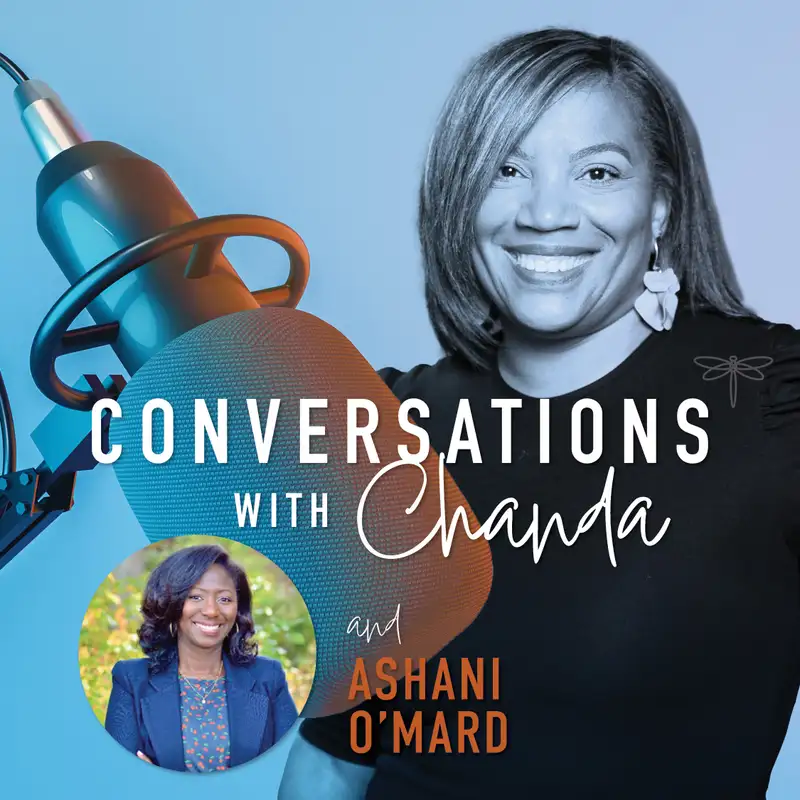
[00:00:00] Chanda Smith Baker: Hello Community. You are listening to conversations with Chanda where leadership gets real and personal. This is where we cut through the noise to confront the issue, shaping our world and our community from power and justice to the heart of community change, hosted by me, Chanda Smith Baker, president, and CEO of the Saint Paul Minnesota Foundation.
[00:00:24] So we are here. Um, in Atlanta and we were just having a conversation because both of us are new in our roles.
[00:00:32] Ashani O'Mard: Yes.
[00:00:32] Chanda Smith Baker: You started in January? Yes, I started last August. So I've got a little bit on you. Yeah. And so when we start, can you just like introduce where you are newly leading. Talk to us about that and maybe give us a little bit about your journey there.
[00:00:47] Ashani O'Mard: I would love to do that. So first of all, welcome to Atlanta. We are so happy to have you. I am, uh, newly appointed as president of the Atlanta Neighborhood Development Partnership. We are a [00:01:00] regional non-for-profit. We've been around for 35 years and we primarily focus on advocating for affordable housing.
[00:01:08] We develop affordable housing and we finance affordable housing. Um. I would love to tell a little bit about my story. Um, I, as I was preparing for this, I've never done a fireside, y'all. So first of all, I just wanna say I'm so excited and when we were prepping on the call, I was like, oh, this is gonna be fun.
[00:01:26] Um. But I love to tell the story about Ani Omar's journey. So I am, uh, born and raised in Detroit, Michigan. Woo. Yes. What up though? Okay. Okay, love that. For the
[00:01:39] Chanda Smith Baker: listener, that was Karla Henderson.
[00:01:43] Ashani O'Mard: Love that. We'll have to chat after this. Um, so born and raised in Detroit, and, um, when I was, uh, graduating, uh, from eighth grade.
[00:01:54] I had the opportunity to receive a, uh, full, fully paid tuition, a [00:02:00] scholarship to a boarding school, um, in one of the most affluent suburbs, uh, within our region, uh, which is Bloomfield Hills. It's called Cranbrook Kingswood. Hmm. And I was a recipient of the Skillman Foundation, which mm-hmm. Happens to be, um, co-founded by, or the found the Skillman Foundation also was, uh, the family of a co-founder of 3M and, um, that particular, what's special about that experience for me is, um.
[00:02:32] My church was located on a street called Woodward Avenue, one of the major thorough fairs in Detroit, Michigan that basically runs due North through, uh, across the city limits. Um, I don't know if y'all have heard of Eight Mile. Usually when I tell this story, college people are like, what's eight mile, uh, the movie.
[00:02:50] But, um, there's, you know, the city limit is, is eight mile, and then you sort of go through the inner ring suburbs. Well after church, uh, on [00:03:00] Sundays we, you know, leave church. Get on eight Mile and literally drive up the street to go to Cranbrook Kingswood, because Cranbrook was also located on Woodward Avenue.
[00:03:11] And over the course of a 30 minute drive as a 13-year-old kid, I just became captivated by the disparities that I would see. I, I, I didn't know, I didn't understand it because I was sort of shifting also from this, what was my normal as a young person, you know? And I, I mean. I just, I grew up in the city and so, you know, seeing vacant buildings in the early nineties, that was a part of the city, that was city life.
[00:03:40] And then, you know, all of a sudden it was like you go past eight mile and there was a whole nother narrative that started to happen and I wanted to know why there was such disparity on the exact same street and. It became something that fueled my passion without me even [00:04:00] knowing I was supposed to grow up and become an engineer because that's what people, people in Detroit grow up to go work for the big three.
[00:04:06] And um, and I thought that was my, my calling as I went to college, I went to Wellesley College and I started taking all these classes in urban studies, or urban anything that had the word urban. I was like, sign me up. I wanna understand more. And I, I literally walked myself by senior year out of a math major because I went to a liberal arts college.
[00:04:29] I didn't even go to an engineering school, ironically. I went to, I went to a liberal arts college and um, my dean, the fall of my senior year, I was like, Dean Daniels, I think I wanna major in urban studies. And she was like. You come to this school to find your passion, we're gonna make that happen. And that's exactly what we did.
[00:04:48] And I, I just never looked back. I, I sort of meandered my way into a banking analyst role and then went to graduate school for Public Policy and Urban Planning, um, at the Kennedy [00:05:00] School. And, um, from there, found myself in a class, uh, that talked about public and private development and. And these seeds that were planted when I was 13 years old, it was like a light bulb went off because I, I just couldn't find the answer to how do you create opportunity and how do you improve neighborhoods?
[00:05:19] And by that time, that toolbox started to get filled with tools, um, that made sense. And so from there, I, this person who presented in my public and private development class in grad school. I went up to him afterwards and I was like, Mr. Lee, how do I work for you? And he's like, that's not exactly how developers do things.
[00:05:42] I know y'all understand that. Like, and developers, you know, they're small shops. They don't have time to be, they don't have time to teach kids. Right. But he said, why don't you send my, your resume to my assistant? And lo and behold, they had a, like a junior analyst. [00:06:00] Internship job that came up after I graduated from grad school and I said yes to it and I have not looked back.
[00:06:07] Um, we develop affordable housing and we finance affordable housing and we do all of this through a very unique private partnership model. Um, we are as good as our partners truly. And um, that is through, um, multifamily development, uh, single family home ownership, as well as single family rental. Um, we'll work with either local builders or mission driven developers and we go to them and we say, Hey, we focus on aggregating capital.
[00:06:37] If you local builder build on time, on budget, uh, we will give you the lion's share of the developer's fee and we will rinse and repeat. That has been the model that we've scaled, uh, since starting this, uh, shift. Thank, unfortunately because of the foreclosure crisis, uh, back in 2008, um, we started with a six home pilot model and we have to this date, [00:07:00] uh, uh, sold over 850 homes.
[00:07:03] Um, through that particular model, uh, we've also entered into a very frustrating, uh, or challenging space of single family rentals. Uh, and through that work we have partnered with, um, a couple of institutional investors. Who, you know, they have all the money, they have all the algorithms, all the technologies, and we've said, how can we recapture homes that quite frankly might not be performing well in your portfolio because you're not necessarily meeting the returns.
[00:07:37] I don't know if anybody ever publicly says that, but I think that's been the reality. Um, how can we recapture those homes, allow them to appreciate and then. Uh, put them back on the market for, for sale, home ownership, uh, opportunities. And then lastly, our multifamily. Uh, we partner with mission-driven, uh, developers.
[00:07:56] Sometimes we lease land into projects. Other [00:08:00] times we, um, might transfer land, uh, to the housing authority to make sure there's a permanently affordable. Um, a component to, you know, having a tax credit deal and something that we've recently done, um, in partnership with the Community Foundation is enter into, uh, multifamily equity investments.
[00:08:20] Um, that's something within the past several years, uh. We were able to, to start to test. And, um, a part of that was, uh, thanks to my experience of serving as founding executive of the Atlanta Affordable Housing Fund. I know you all heard from David Allman earlier. Um, and that was a, a closed in fund that was essentially a proof of concept.
[00:08:42] And so, you know, I signed my name on the dotted line for two years to, you know, really help start that, lift that fund up, raise the capital, deploy the capital. And a part of that journey was understanding the needs of emerging developers who just didn't have the same balance sheet as [00:09:00] other developers who wanted to be in the affordable housing space.
[00:09:02] Um, I found myself here in Atlanta. In the middle of the foreclosure crisis. So I pivoted from the development space because unfortunately very little affordable housing was being developed for quite a while in Atlanta, which is why we have such a huge shortage. That's a part of the reason we have a shortage now.
[00:09:21] Um, but fortunately I was able to pivot to the nonprofit space and. Uh, have kind of found myself, uh, a bit stuck here, but it's been a fun, fun journey.
[00:09:30] Chanda Smith Baker: Fun journey. Thank you for that. And I'm wondering, so from your child's observation in Detroit to your adult observation of coming to Atlantic, any similarities?
[00:09:44] Ashani O'Mard: Ooh, that is interesting. Um, so what we know now about Atlanta is we rank 50 out of 50. In terms of children being able to move out [00:10:00] of, out of poverty, um, and socio uh, economic mobility and, um, it's a conversation we're having now. Um, the mayor's office is leading, leading that work. But, you know, when I think about, you know, the neighborhood that I grew up in, when I think about honestly some of my cousins or, um, just people that I've known for a long time.
[00:10:25] That is a very real trajectory and barrier. Um, depending on where you live, what zip codes you have grown up in will determine your ability to sort of, uh, what your trajectory will be. Um, it'll determine what schools you're able to access. It will determine. Your healthcare, quite frankly. And so I would say from that perspective, yes.
[00:10:50] You know, we're both, you know, at the time, um, Detroit is still a majority black city. Um, I think Atlanta may still be, I should know that. Um, but I, I don't know [00:11:00] that off the top of my head. Um, and so I think from that perspective, you know, we, we are very loyal, um, very loyal people. Um, Atlanta is certainly a cultural hub.
[00:11:13] Uh, we walk around wearing these shirts that say Atlanta influences everything.
[00:11:18] Chanda Smith Baker: Oh, sorry. Detroit against everyone.
[00:11:20] Ashani O'Mard: Um, but, and what's funny about that is that shirt, the person who started that company, um, BA Joiner, uh, one of the co-founders. He was inspired by a shirt that Detroiters wear that says Detroit Ver uh, Detroit versus everybody.
[00:11:34] Right. So there are, I mean, there are some subtleties I think in terms of, um. In terms of just the spirit that people have and the love that we carry for, for the cities. Like I, I will always be a Detroit girl. I haven't lived in Detroit since 1996, but you know, I, I still have a strong roots there and, um, and the reason I do this work, it is, it [00:12:00] is literally because of.
[00:12:01] That drive along Woodward.
[00:12:03] Chanda Smith Baker: I love it. So we've been talking about, um, many things in housing all morning, but I'm wondering for those of us that might need a deeper dive in terms of Atlantis housing landscape, how would you describe the defining features of the housing story here right now?
[00:12:20] Ashani O'Mard: Ooh, it's spicy.
[00:12:23] Yes. It's, it's like a spicy chili pepper. It's a, it's a lot going on and. And I love it. I'm here for it. I've been here for almost 16 years and when I first, again, I moved to Atlanta in the height of the foreclosure crisis, there were crickets. And when I say crickets, I'm talking about not only the lack of development, but quite frankly the philanthropic space.
[00:12:48] At that time, they were not really, they were not, um, interested in engaging in, you know, the affordable housing landscape. Um, probably half of [00:13:00] our community-based organizations that were around back then, or even in the nineties, they went away and they never came back. Or they pivoted away from real estate or liquidated their assets because they had to.
[00:13:13] Um, you know, it was a, a, a situation where we were no longer able to rely, you know, heavily on, um, governmental resources, for example. And if you don't have other, um, funding sources to leverage. You're not gonna survive. So, um, there are a few including a and DP that have survived. But, um, it just, the energy I I see now it's just very different.
[00:13:40] And again, I, when I was, um, helping to stand up the Atlanta Affordable Housing Fund, my first day of work was, uh, the beginning of January, 2020. Right. So, um, I had left A and DB, so at the time I had been with a and DP for about seven years overseeing our, our fundraising [00:14:00] efforts. Also our, um, CDFI loan fund.
[00:14:04] And, um, you know, my boss, John o' Callahan, who I know a couple of, you know, he, I remember him pulling me aside and saying, you know what? You need to think about this impact fund. And I was like, are you trying to fire me? And he's like, no, just trust me. Like I want you to go and you know, just have a conversation.
[00:14:23] Send me your resume. And I'm like, okay, this is weird. But I ended up, you know, meeting with both Mark Pollock and David Alman and I was like, this is interesting. Like. This, it felt very disruptive. It felt necessary. Um, and we did not know that COVID was coming. And so by the time, our goal initially was to raise $20 million, uh, over a pretty much a 18 month period.
[00:14:50] Um, and by March we were like getting ready to launch what we called our friends and family. Um, a [00:15:00] pitch right to high net worth individuals initially, and by that time is when COVID, that, that's when COVID became official. And we were like, we cannot ask anybody for money right now. Like all the money that was being asked was actually coming to the Community Foundation and, uh, United Way to help, to support rental assistance, anything that was needed.
[00:15:21] And so we really pivoted and we said, first of all. How do we reframe this conversation? Right? There are deeper issues, um, that you all know more than anybody else, um, that really started to resonate and harder questions had to be, had to be asked. And so, um, you. Me.
[00:15:44] Chanda Smith Baker: Let's, let's talk about those.
[00:15:45] Ashani O'Mard: Oh yeah, let's, let's get into
[00:15:46] Chanda Smith Baker: it.
[00:15:46] So what are some of the historical forces that are still in play?
[00:15:52] Ashani O'Mard: Ooh. Well, for one thing, when I joined, uh, uh, when I said yes to the Atlanta Affordable Housing [00:16:00] Fund, um. Yeah, at the time there was like an existing board that had been formed previously to do some other sort of think take work, right? And they were bringing on a couple folks like David to the conversation.
[00:16:14] I think Mark came to the conversation, but essentially the existing board, it was all white men. So, you know, here I was having these one-off conversations and interviews. And then they like, you know, had me come an interview with the entire board and, um, y'all did not have a chance to meet Mark Pollock.
[00:16:32] Uh, mark Pollock is a firecracker and he gave me like a 12 page job description. And I read this job description and I was sitting in front of this, you know, group of all white men, and I said two things. I was like, look.
[00:16:47] Chanda Smith Baker: Look,
[00:16:49] Ashani O'Mard: I,
[00:16:50] Chanda Smith Baker: that's the first word.
[00:16:52] Ashani O'Mard: True story.
[00:16:53] Chanda Smith Baker: Yeah. Look at here. I
[00:16:54] Ashani O'Mard: said, I said, look, I, I know I am a [00:17:00] badass person, but I do not walk.
[00:17:01] I'm not Jesus, and I do not walk on water. That's the first thing I said. I was like, this is a lot. So we're gonna have to figure out how we get the support, how I get the support I need to really make this work. And number two. None of y'all look like me. So we need to work on figuring out what strengths we bring, not only from a, a racial perspective, but also in terms of skills, in terms of just making this a, a space that can really drive impact, that is balanced and, and, and thoughtful.
[00:17:38] And they got it. We were able to bring some additional. Um, perspective we were able to bring, um, Sarah Kirsch was, for example, one of our, our, our, um, board members that we recruited to the board, a number of individuals to really just create a space where there was different perspectives coming to the table.
[00:17:58] Number one, that was the, the [00:18:00] first thing, um. I would say in terms of Atlanta, um, and there's a book that I remember reading a few years ago with ULI, um, called Atlanta Rising that really talks about, um, Atlanta's journey into becoming, um, an international city. Um, and one of the things that is underscored in this book, um, that's a subtlety in Atlanta, it's, I don't know if I would describe it as sort of a southern way of doing business, but um.
[00:18:31] Uh, there's this notion of, uh, being incrementalists and how, um, and how the community approaches work. So even when you think about like, uh, the civil rights era, you know, there was like a school of thought of like, Hey, let's not be too. Uh, forceful in, in our endeavors, right? There's one school of thought and then there's another school of thought, like the students who are like, we want this now.
[00:18:58] And, you know, having to [00:19:00] balance that tension, right? That has, that is a part of the DNAI find of, of being a part of Atlanta and really managing, um, through that. And earlier I was sharing with Lisa, um, as a part of the Atlanta Affordable Housing Fund. You know, we were on this journey to try to. Raised $20 million, uh, during COVID in about 18 months.
[00:19:19] Um, we were able to make it to 15, but during that whole time, we thought the witch of Foundation was gonna, you know, come to the table with that last five. And that was like our strategy we're like, if we could just get this 15 raised, you know, they will show up with that last five. And, you know, we get the money raised and we go to talk to them and they're like, Nope, we're not ready When I tell you that crushed.
[00:19:43] My spirit, I was like, how dare you. In the middle of all of this racial reckoning and all that's happening, we've got people who have no place to go. We know, we know the story, we know the value of housing being so [00:20:00] foundational. How on earth can you say no to pennies in this bucket? That was, that was haw.
[00:20:07] That was my, my raw, visceral reaction. However. Yeah, because Atlanta is Atlanta, they needed more time. And who am I to rushed them on that? And what's ironic? So, you know, they said, no, we still closed the fund, we still deployed the capital. It was still a wonderful story. And we made a decision to, um, to roll up under the community foundation.
[00:20:30] And at that time, John OC Callahan, my boss, was like, Ashani, I need you to come back to a and DP. And so I agreed to go back to A and DP because quite frankly. Your girl was tired. I mean, like standing up at Impact Fund. I mean, it was the most incredible thing I've ever done in my life, um, professionally, but it was really, really hard work.
[00:20:53] Um, and I was exhausted. I have teenagers that are starting to graduate now, and so I made the decision to go back [00:21:00] to A and DP because I knew what to expect and um, and I knew sometimes you have to let the, the birdie fly from the nest and somebody else. Takeover. Right. So that worked out wonderfully for me.
[00:21:12] Um, but what's special about that story, um, is that once I got back to a and DP, once Sarah was hired to sort of take the new phase of, of the fund to ano another level, the the Woodruff Foundation, they started to have conversations with the community foundation. They called me. Had conversations with me, they had conversations with John, like they started to figure out, you know what?
[00:21:41] We, you know this, this thing is working. Like how can we really. Play a major role in this, and we were able to, I was able to share my lessons learned. You know, mark and David, they shared their lessons, learned the community foundation, shared their aspirations, and sure enough, they came to the table with, [00:22:00] um, a hundred million dollars.
[00:22:01] So, you know, it's, it's one of those lessons. I know I have to work on my patients. I'm the first to admit it. Um. But it, it really is a, uh, it is a journey and, you know, Atlanta, the way that we do things, it is oftentimes collaborative, but it can be slow. And I don't know if that's any different in, um, the Twin Cities, but that is certainly, that was my, that was my lesson learned.
[00:22:29] And I mean, I, and I, I had to, I was really, I was really upset. Like I was really, I was high. I
[00:22:35] Chanda Smith Baker: was
[00:22:36] Ashani O'Mard: big. Yes. But at the same time, it was definitely a lesson like, because they needed to also figure out how they wanted to show up. Right. And that's, that's their journey to figure out. And I mean, there could have been no better outcome than for them to not only show up with the a hundred million dollars commitment, but then what happened very brilliantly.[00:23:00]
[00:23:01] The mayor of Atlanta, mayor Dickens, he was like, oh, lemme put some skin in the game and let me put a a hundred million dollars housing opportunity bond on the table. Now mind you, the fund it, it's set up for the five county metro area. But because he was able to bring that additional capital to the table, you know, probably 70% of their fund is, has been concentrated in Atlanta because they have those additional resources.
[00:23:30] As a part of the capital stack when developers are, are building out, um, affordable housing. So it's, it's a very interesting, um, story on how Atlanta works, right? And how we, how we go about business. It is very much, there's still a collaborative spirit and to me that changed. During COVID, like that is as, as how a TL was being stood up, which I know you all have probably talked to.
[00:23:57] How's a, uh, the folks at house a TL [00:24:00] today? Um, there just became this very intentional alignment, um, so that everybody's at the table, which is awesome about this room. It's like your whole ecosystem is here and I think we've started to really pay attention to how do you bring. The ecosystem together to strengthen it.
[00:24:17] Right? How do you identify the gaps where they're needed? I think what has really come out of the past five years is also understanding, you know, A and DP. I'm gonna talk about our amazing work, but we need more A and DPS here in Atlanta. That's kind of when I went to the Affordable housing fund and I was meeting with developers, I was trying to figure out how do you deploy this capital We've raised, what I started to realize was.
[00:24:43] Our nonprofit capacity was struggling. Like we don't have a lot of like, self-sustained, you know, nonprofits that are doing stuff at scale.
[00:24:55] Chanda Smith Baker: Say more about, say more.
[00:24:57] Ashani O'Mard: Well, um, I [00:25:00] think many of them struggled, um, because of the, sort of the shift. There were some things that probably happened before I, I landed in Atlanta.
[00:25:08] Um. That,
[00:25:11] Chanda Smith Baker: but why is that such an essential piece, the, the nonprofit developers, like you're saying they were struggling. Like why was the struggle so noticeable? What gap did that present?
[00:25:20] Ashani O'Mard: So the nonprofit developers alongside private developers, but I mean, when we think about who was building affordable housing, you know, it was a lot of nonprofit developers that were a part of that equation.
[00:25:34] They were leveraging, um. You know, CDBG funds or home fund, like they were finding ways to, you know, create home ownership opportunities. And once funding dried up and I think philanthropic support, maybe like late nineties, early two thousands started to dry up. Um, not to mention the foreclosure crisis, you just saw less production, right?
[00:25:57] There was just, there's less that was being done. [00:26:00] And, um. There have been newer organizations that have emerged since that time. Um, more focus again, sort of place-based organizations that I think y'all are visiting. The West Side Future Fund, they're strong partner of A and dps. Um, but
[00:26:20] it, I, I think we've all, we are all starting to reinvent how we do business. Um, we had to reinvent how we. We did business after the foreclosure crisis. That was around the time we changed leaders. So a DP was founded by, um, an amazing, um, black woman by the name of Hattie b Dorsey, uh, uh, the late Hattie b Dorsey.
[00:26:41] She recently passed and, um, she was president and C for about 15 years. And then John OC Callahan came on. Like right before the foreclosure crisis started. And so, um, to that point, we were very centric and focused on Atlanta, um, and historical neighborhoods and, [00:27:00] and CDCs that were supporting, um, some of our historic neighborhoods.
[00:27:05] Um, we were helping with capacity building, we were teaching, uh, curricula, uh, and partnering with Clark Atlanta on a Master's of community development. Like all these things, like that's kind of what we were focused on. And then. You know, and we were doing stuff around mixed income communities, and then John came on literally right as the foreclosure crisis was starting, and it was like, hold up.
[00:27:29] How do we pivot and be responsive to what's going on? How do we become. Not just focus on place-based efforts, but if this is impacting our entire region, we've got to pivot how we think about this. And so we expanded our footprint to really focus on the 10 county metro region, and we were able to do that through leveraging, um, neighborhood stabilization, um, dollars.
[00:27:57] Uh, from there we started to, [00:28:00] as those were sunsetting, we started to secure private, uh, program related investments, um, enterprise level debt. And, and now what we do and what really sort of multiplied our, our production on our single family home ownership. Is leveraging new markets tax credits for home ownership.
[00:28:19] Um, we were probably, I believe we were the first outside of the, uh, habitat for Humanity, um, international footprint to actually innovate and leverage those funds. We used their consultant. Uh, we went to, um, the National Community Stabilization Trust. They have a home ownership alliance. Uh, we started to talk to other nonprofit developers about how do you leverage these funds?
[00:28:44] Um, and just, uh, probably about a month ago, um, all three organizations that specifically leveraged new markets, tax credits for home ownership, they all received allocations. Huge win for this work and the advocacy work [00:29:00] that we're doing. Um, and, um, we have to date received six sub allocations from, uh.
[00:29:08] Community development entities or CDEs that receive those allocations, um, which have totaled about 44 million. So once we get those, that, that type of money allowed us to go from, you know, on average probably, uh, producing about 60 homes, 70 homes a year. Um, to, at our highest point we were probably at just over a hundred homes that were, were focused on home ownership opportunities.
[00:29:34] It allowed us to have more developer subsidy. It allowed us to take the net benefit of those funds and provide down payment assistance to home buyers that were earning 80% of the a MI or below. Um, and then it allowed us to recycle those dollars. So we have an internal rotating fund that allows us to, uh, leverage dollars as we.
[00:29:57] Um, secure new philanthropic, uh, [00:30:00] dollars or in fact, you know, capital magnet funds, for example. Yep.
[00:30:05] Kizzy Downie: Um, and you guys are amazing. You are amazing. Thank you. Um, I've heard a lot of the conversation around production, which is really important in terms of creating the kind types of communities that we should have and deserve to have.
[00:30:21] Uh, for, for the folks that live here. Um, my question is about like the preservation, like there's a lot of units coming online. There were units here before. Yeah. Like how much of your work and how much of the resources that you all put in place helps kind of focus on the preservation aspect as well.
[00:30:41] Ashani O'Mard: So, great question.
[00:30:45] When we first started this foreclosure, like during the foreclosure crisis. Like a hundred percent of what we were doing. It was foreclosure redevelopment. We had banks knocking at our doors with REO [00:31:00] properties like, we're gonna donate these. We don't know what to do with them. That's how we started. We had a six home pilot that we started.
[00:31:08] We didn't know what we were doing, but we were like, you know what? This is an opportunity to restore a pathway to home ownership for a, for a working family. And so that's how we started. And so most of what we do on the single family home ownership side, as well as the single family rental side, it is preservation.
[00:31:28] Um, and I like to think of preservation as the fastest way to create affordable housing, right? I mean, it's, it's something that's already, um, existing. Uh, typically we will, you know, put in a certain amount of rehab dollars into a home. Um. And I mean, we're trying to, again, this single family rental thing is not my favorite thing.
[00:31:52] Um, we're trying to figure it out. Uh, we partner with, um, property, third party property managers. So we have [00:32:00] two major property management partners, um, who we've split a, um, portfolio of about 260, uh, units between the two. And then we have one unique situation where it was like a, a newly constructed. Um, maybe about six or eight homes that we have a third property manager hand handling.
[00:32:20] He's one of our, um, builder partners who we typically work with on our home ownership side. But, um, that has been our strategy. It is preserving. Um, on the multifamily side, we've had some wholly owned assets that. We've had to have some very honest conversations with ourself on, like our muscle and ministry is not on the multifamily side if I'm, if I'm being honest.
[00:32:46] Right. Like, and actually during the foreclosure crisis, there was one of the nonprofits that had been a very strong nonprofit. They went under and, uh, the county approached us about, um, taking over two of their [00:33:00] multi-family properties, which we did wholly owned, but. We are not a asset manager. We are not a we, we, that's just not what we do well.
[00:33:09] And so we've actually, um, as of within the past year, um, we have, um, sold one of our, uh, senior properties to national church residences. Um, it was, you know, they are the best at sort of affordable senior housing and, um, they were able to res syndicate that property, um, and receive a allocation of, um, 4% tax credits.
[00:33:34] Uh, we have another property, one of the ones that was sort of gifted to us that also recently received an allocation of tax credits. We're hoping to close that. Within the next couple of months, we'll, uh, maintain a small sort of ownership as a part of the jv, but we're, our model is let the experts go be great, right?
[00:33:53] Like we aggregate the capital. Um, that's something we're really good at. Um, and we're really [00:34:00] good stewards at how we leverage our, our dollars and how we deliver on those dollars. Um, but we're like, you know what? You tax Reddit developer, you go be great. Um, we will lease that land into the deal. Or, um, you local builder, you go build or you go rehab this property and we will incent you if you do well.
[00:34:20] And if you lose money, you know, we're probably gonna take your, a portion of your construction management fee. We're gonna take something like we all have to have skin in the grain. So that is, that's been our approach to, um, but most of what we do has been on the. At least on the single family side, it's been on the, the rehab side.
[00:34:37] And then to your point, the preservation play on the multifamily side. Without us having to take that risk of, again, being the asset manager, we have shifted to providing equity investments that minimizes our risks, you know, as we, you know, look to preserve, uh, affordability. Mm.
[00:34:57] Chanda Smith Baker: Akua Ellis,
[00:34:59] Acooa Ellis: number [00:35:00] one. I wanna applaud you for, um, what I just heard, you name, just the courage to name what you're not good at.
[00:35:06] Yeah. Um, I think there is pressure, particularly in the nonprofit space, um, and resources being what they are. To, to try to adapt, to meet where resources are. But I think it takes courage to have clarity and name that a thing is not necessarily your jam and to, um, you know, to support others in, in being.
[00:35:28] Great. Uh, my question is around the capacity challenge that you made earlier. Is there a consistent theme in where that investment is needed among non-profits? Like, is there an area where there, there is consistent challenge? In their capacity?
[00:35:44] Ashani O'Mard: Mm.
[00:35:48] Oh, that's a, that's a interesting question. Um, when I think about, when I think about my friends or my colleagues in this space, [00:36:00] um, I definitely think it varies. Um, some of us might lack, um, the fundraising capacity. Um. Some of us might lack the balance sheet. Um,
[00:36:17] some of us might lack the vision, like the strategy. I mean, some of us are just all over the place and you just sometimes you have to like
[00:36:25] Kizzy Downie: find your lane.
[00:36:26] Ashani O'Mard: You gotta find your lane and understand how to do that well. Um.
[00:36:35] Yeah, and that's probably an, an opportunity for Atlanta and for our nonprofits to better align on how we support each other. I think we're making strides with this, um, umbrella convening organization of house a TL, where we are getting in the same rooms together. We're, you know, um, advocating for the same [00:37:00] things.
[00:37:01] Um. But I think it's a work in progress and I think everybody has a different journey. Some of us are more place-based. Um, some of us have, they, we just have different funding models. Like what I love about us is we leverage our dollars, our every, for every philanthropic dollar, um, that we've received in this, within the past five years, we've leveraged it by 25.
[00:37:27] And, and we are able to do that because of these. Additive sources we are bringing into the ecosystem, um, and the way that we structure our capital stack. But there are oftentimes, if you're play space, you're just going deeper in terms of services, in terms of you might be have a land trust or you might just need $200,000 in one home, and that's just not our model.
[00:37:52] Like our model is to say, how do we take about 10 to 15,000 of our philanthropic dollars and then layer it with other things? And [00:38:00] so that means we can do more and we can scale. So it's just different. Yep.
[00:38:04] Chanda Smith Baker: Andrea,
[00:38:04] Andrea: uh, yeah. So thank, thank you so much for the work that you're meeting, and I just wanted to comment on, um, yes, I think that, um, we all need to, uh, accept patience as part of, um, part of what's necessary for ideas to, to marinate, but also really appreciate people like you in your leadership and pressing issues.
[00:38:24] So thank you for that. And so my question for you is, can you talk a little bit about how. It was different or how it is different of doing the, raising the capital and the capital at, um, and, and p um, relative to doing that for the affordable housing fund, whether you're using it for their debt or after the either way.
[00:38:46] But, and maybe it's very similar
[00:38:49] Ashani O'Mard: or No, it's totally different. Thank you for the question. So, um, I. I would joke around with, um, my board, our investment [00:39:00] committee at the Atlanta Affordable Housing Fund, and I, I called them my gunslingers. Right? They were all developers and just, you know, at the drop of a coin, you know, they could pick up the phone and.
[00:39:12] And call someone or they would have a deal, you know, that we were looking at things just moved at such an amazingly fast pace. Um, many of both David and Mark were, you know, early investors into the fund. Um, it, it just had a different cadence. Um, and at the time we were very intentional about bringing new seasoned real estate professionals to the conversation.
[00:39:38] Bringing new, um, investors, quite frankly to the conversation we have this physicians who, you know, wanted to do something different, um, and, and get a moderate, uh, rate of return on, on their investment. Like, so it, it's just a, it was just a different, um, space of how we approached this work, which I, I [00:40:00] loved because, you know, I formerly worked for developers and so I appreciated that fast pace, whereas, um.
[00:40:08] At A and DP we're just more intentional. You know, we've been around for a very long time. We have very trusted relationships with funders. Um, again, we are really good stewards and we have a, a amazing fundraising team. I'm so glad I'm not a fundraiser anymore, although technically I am still a fundraiser, but
[00:40:28] Chanda Smith Baker: technically
[00:40:28] Ashani O'Mard: it's a lot of work, right?
[00:40:30] Um, and so it's, it was just, it was just different. Um. In terms of, uh, how we were approaching the work. We didn't start doing equity investments at the Atlanta Affordable Housing Fund until I left. Um, so most of what we were doing, it was like short term capital. Um, you know, it's a 10 year, uh, fund in terms of the, the length of it.
[00:40:51] So everything had to be within a certain amount of time. Um, but it was, what was lovely for me in that space [00:41:00] was just learning like it, it was almost. First of all, I was building everything. I was building, you know, um, investment guidelines, PowerPoint, pitch decks. I was preparing, you know, the board for their meeting.
[00:41:11] I was like a one one woman shop. Um. And thankfully I convinced them to allow me to hire an underwriter because that's something I'm not good at. And so, um, she was incredible, like just a powerhouse and, um, a former investment banker. And so it worked out so that we were just able to move very fast and also lean on the expertise of our, of the board.
[00:41:36] Um, whereas a DP is just structured a little bit differently, um, as a nonprofit, uh, you know, we. Um, we prepare our board for the meetings, but you know, we sort of give them all of the working agendas, all the notes, all the committee reports, and, um, and work closely in partnership with, um, our banks, our. Um, local organizations, uh, [00:42:00] very different dynamic, I guess.
[00:42:01] Mm-hmm.
[00:42:02] Chanda Smith Baker: Carla Henderson.
[00:42:03] Karla Henderson: So, um, congratulations on all you accomplished and it warms my heart to see a fellow of Detroit Yeah. Making you her mark in another city. Thank you. In Minneapolis four years ago.
[00:42:14] Ashani O'Mard: Wow.
[00:42:14] Karla Henderson: Um, and I can see you a 13-year-old
[00:42:18] Ashani O'Mard: mm-hmm.
[00:42:18] Karla Henderson: Black girl in the back of seat.
[00:42:20] Ashani O'Mard: Mm-hmm.
[00:42:20] Karla Henderson: Driving down Woodward and hitting Ferndale and then ham and then Yes,
[00:42:25] Ashani O'Mard: that's right.
[00:42:25] Karla Henderson: Yeah. I mean. Um, so that resonated with me. One of the things that we keep hearing, we've heard a lot this morning, is about the vision of the mayor. So could you describe how that has galvanized or like how everybody just kind of, it sounds like people just kind of fell in line, like, this is what the mayor wants.
[00:42:47] This mayor, mayor, mayor. Like we heard it. On every panel. Yeah. And what that difference has made for Atlanta in terms of,
[00:42:55] Ashani O'Mard: did they talk about our group project?
[00:42:57] Chanda Smith Baker: Yes, yes. Yes. And [00:43:00] did they just fall in line? Did they just fall in line? Was it that simple? Yeah. Ooh.
[00:43:06] Ashani O'Mard: Well, that's a great question. Um, well, so well, I'll start, start by saying first, when the mayor was first elected, he used to talk about drawing circles.
[00:43:17] Like he was like, I don't draw lines, I draw circles. But the group project definitely resonated and, and I talked earlier about the, the importance of alignment. That's the moment that Atlanta is in right now because you've got the attention of, of our mayor who is really sort of setting the strategic vision.
[00:43:39] He has prioritized affordable housing as the number one focus for, for this city, and fortunately before he became mayor. He was starting to learn the importance of what that meant and, and why it was needed. He was working on ordinances for I inclusionary zoning and, and [00:44:00] just doing things to help, you know, piece together this framework, you know, before he even knew he was gonna run for mayor.
[00:44:07] Um, and so having his voice at the table, having that a hundred million dollar match immediately that sent a message. And when I tell you, everybody got information, y'all know Beyonce, right?
[00:44:21] Chanda Smith Baker: Yeah, we do. We know her. Listen,
[00:44:24] Ashani O'Mard: this whole city, our philanthropic community got information that was probably the most powerful thing, aside from saying, you know, housing affordability is the number one issue is putting your money where your mouth is.
[00:44:39] And from there, we've just seen this shift. And again, you know, and I, I, you know, I'm gonna, I'm. I'm not gonna boast on the Affordable Housing Fund, but the timing of the Affordable Housing Fund, improving a concept is something to not be taken lightly. Uh, we had smaller organizations who [00:45:00] they didn't know.
[00:45:01] We used to joke David, David Alman, who you all talked to earlier. We used to have these conversations in these pitch meetings, or you know. A foundation will be be like, well, you know, we don't really know how to do impact investing. Right. You know, a lot of small shops, they just don't have the capacity.
[00:45:17] Talk about lack of capacity. These smaller foundations, they don't. It's like one person on staff and so. You know, they were very hesitant, like, how do we do this? How, you know, what does reporting look like? You, you mean you gotta, we gotta make sure we get the money back. We just wanna give the money out.
[00:45:34] Right? They have these conversations and, and at one meeting I remember David being like, you know, it's sort of like a houseboat. Like nobody wants a houseboat. Like you either want a house or you want a boat. Nobody wants a house boat. And it, I mean, it's true. Like I think that's how the foundation community, they were like, what do we do with this, this social impact stuff?
[00:45:54] And so, and mind you, the whole country, except for Atlanta, like, was like, duh. Like it's a great way to like [00:46:00] recycle your philanthropy, like you do more. But, um, it, it really, um.
[00:46:08] Acooa Ellis: Wait, what was the question?
[00:46:09] Chanda Smith Baker: I have, I have You got it? You got it? I have, I have, I have two more things and we gotta wrap in seven minutes.
[00:46:15] Oh, wow. This is so bad. So on. It is. So on our call, we talked a little bit about, um, corporate entities that we're buying up single family homes.
[00:46:22] Ashani O'Mard: Yes.
[00:46:23] Chanda Smith Baker: What is that doing to access and affordability and how are you addressing it?
[00:46:28] Ashani O'Mard: So, um, that there was a time, uh, a few years ago where, um. A report had come out showing indicating that 30% of Atlanta's housing stock had been purchased by institutional investors.
[00:46:47] So similar to like how we were ground zero for the foreclosure crisis. As a part of that, we then became this hotbed where it was easy, our tenant laws weren't strong, uh, tenant protection laws, and [00:47:00] so, you know, they were just gobbling up. Housing and who knows what was happening, right? It was like they were just not a part of what was available.
[00:47:10] So that was pushing, um, first time home buyers out of the market. Um, it was certainly causing a problem for a and DP. You know, we had traditionally had this model of acquiring, you know, homes and, um, even when they weren't foreclosed, we'd, you know, acquire homes and rehab them and then make them available for, for, for homeowner.
[00:47:29] For home ownership. And I remember this was probably, um, at the time where Mayor Bottoms had assembled like a team. I, I don't even think she was still mayor. I was just coming back to Atlanta as a matter of fact, I mean to a and DP. And, um, one of these big institutional investors, they wanted to talk to the housing authority.
[00:47:51] Just sort of figure out, I think, how to have a better path of goodwill and um, you know, how they might be able to partner with the [00:48:00] affordable housing community. And I remember sitting there in that meeting thinking, well, if you just. Give us your algorithms or you know, like you could help us by like, just share with us what you're doing so we can better acquire property.
[00:48:17] We cannot compete with the fact that you have this liquidity and that you're buying stuff site unseen. Like, it just, it just was squeezing so many people out of the market. And so, um, the way that we dealt with it, Chanda is. If you can't beat 'em, join 'em. Right? Mm-hmm. I need to know your playbook, and that's what we've been doing.
[00:48:41] We've been partnering with institutional investors to say, look, you've got the code. You wanna do good, then you need to work with. Mission-driven partners. Mm-hmm. And, um, and it's not a perfect journey. It's working. We're figuring it [00:49:00] out.
[00:49:00] Andrea: Okay.
[00:49:00] Ashani O'Mard: We're still figuring it out. You know, there are other players that are focused on partnering with, um, institutional, uh, investors.
[00:49:08] I think grounded solutions. Network is, is probably the national leader in that.
[00:49:12] Chanda Smith Baker: Well, Shawnee, tell us about the Close the Gap Fund.
[00:49:15] Ashani O'Mard: Yes. So Closing the Gap campaign, the Closing the Gap, uh, initiative was launched by A and DP crazy enough in the middle of COVID. Um, a very ambitious goal that focused on over the course of a five year period, uh, creating and or preserving 2000 homes, we wanted to double our loan fund.
[00:49:37] Which, gosh, at the time may have been in the 12 millions or something like that. And um, and just really focused on providing down payment assistance to. To home buyers. We are also a federal home loan bank, uh, member. Um, and so that's a source that we typically leverage in providing, um, not only to a and DP home buyers, but non A and DP.
[00:49:57] Home buyers can take advantage of that. Uh, [00:50:00] we just closed that initiative as of December 31st. Uh, our initial campaign goal was to raise 18 million. We were able to actually raise 20 million. And we received an additional match from, or a contribution from Truist to take us up to 25 million. And, um, as a part of that, we, um, exceeded our goal and created and or preserved 2013 units of housing in Atlanta.
[00:50:30] We were also able to invest in over 2,700 units. Of affordable housing in through our loan fund, which was phenomenal. Our loan fund grew about three and a half the size. And in terms of our production from the previous five years to the past five years, we tripled our impact. And so it's something we're super proud of that represents about 1.1 billion in total development costs.
[00:50:57] Um, a 25 to one [00:51:00] leverage, uh, that we talked about earlier. So that 25 million. Uh, we were able to raise about 26 million in federal com federally competitive resources. Any NeighborWorks organizations here? Yeah. Excellent. So, yeah, so including NeighborWorks, including new markets tax credits, including the CDFI fund, um, including the new markets tax credits that we've, uh, accumulated.
[00:51:21] And then we had our internal rotating funds that we were able to rotate funds through. So it's a, it's a pretty incredible story we got out about. I think it was 8 million in down payment assistance, um, uh, during that five year period as well. So, um, very, very proud of that work. Um, again, for us it's about stewardship.
[00:51:43] It's about. Finding ways to aggregate the capital and then finding the right partners to get the work done.
[00:51:51] Chanda Smith Baker: Hanni Omar,
[00:51:55] Ashani O'Mard: we did it.
[00:51:56] Chanda Smith Baker: We did do it. I was like, you know, it's the [00:52:00] afternoon energy is low, but I'm quite excited about housing now. Oh,
[00:52:03] Ashani O'Mard: very good.
[00:52:05] Chanda Smith Baker: You brought the energy and the innovation. Thank you so much for joining me in this conversation.
[00:52:09] Ashani O'Mard: Oh, thank you. This has been a pleasure. Thank y all so much for all that you're doing. Thank you. Oh, and do know, I, I do have one more very, very important thing to say. I could not join you for dinner last night because I have these teenagers. I have junior, senior, teenager, uh, or senior in high school, junior in high school, and um, they're at very different schools.
[00:52:28] One is a relatively conservative school. One is a very progressive school. Um, but they are both focused on, um, in solidarity walking out on Friday, and I wanted to be there to support them. I want you to know that the nation is with you, our hearts are with you. Um, this is heavy work and, um, I just getting emotional, even talking about it, but I needed to be there to support them, um, as they sort of figure out this journey.
[00:52:58] And I, it's, I'm inspired by [00:53:00] the next generation. Um, as they really navigate how to elevate their voices through all that they're experiencing, um, in this nation right now. So. Yes.
[00:53:15] Chanda Smith Baker: Thank you for listening to Conversations with Chanda, hosted by me, Chanda Smith Baker, president, and CEO of the Saint Paul and Minnesota Foundation. To hear more conversations with change makers, visit conversations with Chanda.com, conversations with CHANDA, or find us on YouTube or wherever you get your podcast.
[00:53:35] If you'd like to learn more about the work at the foundation, please visit spmcf.org.